

Indonesia has a dancing president. There is no need to panic. The republic has survived political dramas, economic turbulence, natural disasters, and enough bureaucratic paperwork to exhaust an entire generation. Surely, it can survive a few presidential dance moves.
President Prabowo Subianto’s distinctive movements have become part of his public persona. Some people find them charming. Others watch with the uncomfortable expression of someone who has accidentally opened the wrong video in a family WhatsApp group.
But perhaps we should stop arguing about whether the president dances well. Indonesia has much bigger problems than choreography.
On October 20, 2026, Prabowo and Vice President Gibran Rakabuming Raka marked two years in office. It is a convenient moment to ask whether the administration’s political performance is keeping pace with its governing performance.
After all, a country is not a talent show. The presidency is not a stage, the national budget is not a production fund, and public welfare cannot be measured by the volume of applause.
The president may control the choreography on stage. The public must judge what happens offstage.
Enter Homo Ludens: The President as Performer
In 1938, Dutch historian Johan Huizinga published Homo Ludens, arguing that play is a fundamental element of human culture. Human beings are not merely creatures who think (homo sapiens) or work (homo faber). They are also creatures who play (homo ludens).
Huizinga gives us a useful defence of presidential dancing. A president is still a human being. He can enjoy music, tell jokes, laugh, and move his body without first consulting the constitutional lawyers.
Nobody should expect a president to spend every waking moment looking like a marble statue outside a government building.
A little spontaneity can make a leader seem approachable. A sense of humour can soften the distance between the palace and the people. Even a questionable dance move may have greater entertainment value than a three-hour bureaucratic presentation on institutional coordination.
But Huizinga did not write Homo Ludens as a presidential performance manual. He was exploring the role of play in culture, not offering political leaders a philosophical exemption from accountability.
The distinction matters. A president can be playful without governing playfully. He can dance on stage while remaining deadly serious about public policy. Equally, he can look solemn in front of the cameras while presiding over policies that fail spectacularly.
The problem, therefore, is not the dance. It is the possibility that politics increasingly rewards the performance of leadership more than the substance of leadership.
In the age of social media, a presidential dance can travel across the internet in seconds. A complicated policy failure, by contrast, may require an investigative report, a spreadsheet, and a citizen with extraordinary patience.
Guess which one is more likely to go viral.
When the President Dances, Does the Haze Disappear?
Unfortunately, smoke does not respect political charisma.
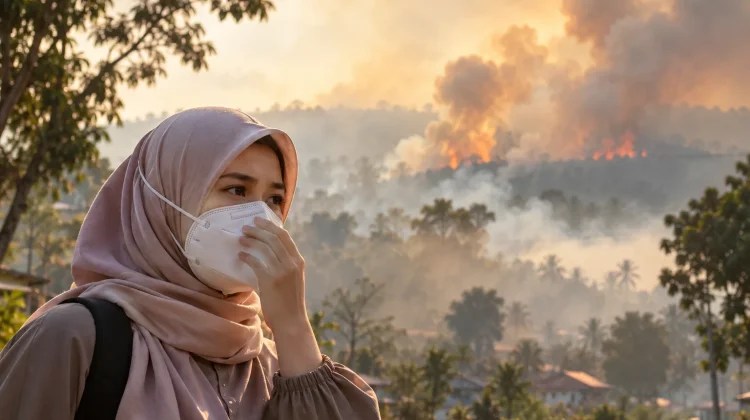
Indonesia’s recurring forest and land fires are a reminder that the country’s most pressing problems do not always respond to presidential optimism. When fires spread across Sumatra and Kalimantan, haze can travel across borders, disrupt daily activities, threaten public health, and expose weaknesses in environmental management.
Imagine the scene. The president is dancing. The cameras are rolling. Social media is delighted—or horrified, depending on personal taste.
Meanwhile, a parent is wondering whether it is safe for a child to go to school. A worker is trying to earn a living in polluted air. A family is worrying about medical expenses. Officials are coordinating an emergency response, while the public wants to know why the same problem keeps returning.
There is a rather obvious difference between these two scenes. One produces content. The other demands competence.
To be fair, no president can eliminate every forest fire. Drought, extreme weather, land-use practices, and other factors complicate the problem. But governments can improve prevention, enforce environmental regulations, protect peatlands, hold responsible parties accountable, and strengthen emergency preparedness.
That is where leadership must be measured. The public does not need the president to stop dancing. It needs the government to stop treating recurring crises as if every dry season were an unexpected plot twist.
If the same environmental problems keep returning, the question is no longer merely whether the response was impressive. It is whether the country is learning enough to prevent the next crisis.
A successful government should not only arrive when the smoke becomes impossible to ignore. It should help ensure that fewer people have to breathe it in the first place.
Indonesia: A Nation of Disasters, Both Natural and Man-Made
Indonesia’s geography guarantees exposure to earthquakes, volcanic eruptions, floods, landslides, droughts, and other natural hazards. No administration can promise a disaster-free archipelago.
But geography is not an excuse for institutional complacency.
The difference between a natural hazard and a national tragedy often lies in preparation. A river may overflow naturally; whether communities have adequate drainage, reliable warnings, safe evacuation routes, and resilient housing is partly a matter of public policy.
A landslide may be triggered by extreme rainfall; the scale of the damage can also depend on land management, settlement patterns, and enforcement. A forest fire may be intensified by drought; its spread and consequences can be influenced by prevention and response.
The government cannot control nature, but it can influence how vulnerable people are to it.
This distinction should guide any fair assessment of Prabowo’s administration. Criticism should not blame the president personally for every flood or fire. It should ask whether his government is making the country better prepared, more resilient, and less likely to repeat preventable mistakes.
Unfortunately, disaster management rarely produces the sort of imagery politicians enjoy. A functioning drainage system is not particularly photogenic. A well-maintained early-warning network rarely attracts a standing ovation. Peatland restoration is unlikely to become a viral dance challenge.
Yet these unglamorous achievements can save more lives than a thousand ceremonial speeches.
Perhaps that is the real challenge of governing: doing the work that matters even when it does not make an attractive campaign video.
The Economy Does Not Dance to Presidential Music
If environmental disasters test the state’s capacity to protect people, the economy tests its capacity to improve their lives.
Here, too, the distinction between appearance and reality is essential.
Economic growth may look reassuring in a presentation. Financial markets may provide encouraging headlines—or sudden shocks. Government programmes may be launched with ambitious promises. But ordinary Indonesians experience the economy through rather less abstract indicators: food prices, rent, school fees, transport costs, wages, job opportunities, and the money remaining at the end of the month.
For a household struggling to balance its budget, a national growth figure can feel rather like being told that the weather is beautiful while standing in the rain.
This does not mean Indonesia’s economy has collapsed. A responsible critic should not confuse market volatility, declining confidence, or household financial pressure with a complete economic breakdown. But neither should an administration confuse headline growth with universal prosperity.
The reported concerns surrounding Indonesia’s capital market in October 2026, including questions about transparency and investor confidence, deserve serious attention. A market setback is not the same as an economic catastrophe, but it can be a warning that institutions need strengthening.
Investors need predictable rules. Businesses need confidence. Workers need productive jobs. Families need purchasing power. Young people need a credible path towards economic independence.
These are not competing demands that can be resolved through better publicity.
The government must demonstrate that its economic policies produce tangible benefits, especially for those who have the least room to absorb rising costs or unexpected financial shocks.
And here is the uncomfortable question: if the economy is supposedly moving in the right direction, how many citizens can actually feel the difference?
The answer cannot be supplied by a podium, a slogan, or an enthusiastic applause track. It requires evidence.
The Politics of Looking Busy
Modern governments have mastered the art of looking active.
There are announcements, launches, ceremonies, coordination meetings, official photographs, ambitious targets, and statements promising accelerated implementation. Every problem appears to have a task force. Every task force appears to have a meeting. Every meeting appears to produce another commitment.
And yet, the public eventually asks a remarkably simple question: what has changed?
A programme should not be judged merely by the number of people attending its launch. A disaster response should not be judged solely by the number of officials appearing at the site. An economic initiative should not be celebrated simply because its name sounds impressive.
The relevant questions are less glamorous. Was the programme effective? Was the money spent properly? Were the intended beneficiaries reached? Did the intervention improve outcomes? Were mistakes acknowledged and corrected?
Consider public nutrition programmes. Counting meals is useful, but nutritional quality, food safety, procurement integrity, and improvements in children’s health matter just as much.
Consider disaster response. Deploying emergency personnel is necessary, but preparedness, speed, coordination, and the protection of vulnerable communities also matter.
Consider environmental policy. Issuing regulations is one thing; enforcing them consistently is another.
In each case, activity is visible. Impact must be demonstrated.
A government can look extraordinarily busy while leaving fundamental problems unresolved. It can also achieve important results without making every achievement a public spectacle.
Perhaps the most useful performance indicator for a government is not how often it announces action, but how often citizens can see that the action has worked.
The President’s Dance Floor Is Not the Country’s Report Card
There is a temptation, especially in an increasingly polarised political environment, to turn every presidential gesture into a referendum on national leadership.
If the president dances, critics call him unserious. If he looks stern, supporters may call him decisive. If he jokes, some see warmth; others see a lack of gravitas.
This is politics reduced to facial expressions and body language. It is also an inadequate way to judge a government.
A president can dance badly and govern effectively. He can dance brilliantly and govern poorly. He can look commanding while making questionable decisions, or appear relaxed while overseeing competent institutions.
The correlation between dance moves and administrative capability has yet to become a credible basis for public policy.
But there is a more serious concern. When politics becomes too focused on personality, the public risks becoming an audience rather than an active participant in democratic accountability.
We begin discussing the president’s latest performance instead of examining the performance of public institutions. We debate whether a gesture is dignified while neglecting whether public expenditure is justified. We share entertaining clips while overlooking complicated questions about employment, environmental protection, or the quality of public services.
The solution is not to ban political entertainment. It is to refuse to let entertainment become a substitute for scrutiny.
Citizens can enjoy the show and still read the accounts.
Indeed, that is what a healthy democracy should encourage.
Two Years On: The Audience Wants Results
Two years into the Prabowo-Gibran administration, the country deserves an assessment more substantial than a popularity contest.
The government should be judged on whether it has improved disaster preparedness, strengthened environmental enforcement, supported household purchasing power, expanded productive employment, protected public resources, and made public institutions more accountable.
These are difficult objectives. They require coordination, patience, technical competence, and decisions that may not produce immediate political rewards.
They also require honesty. Not every policy will succeed. Not every target will be met. Not every disaster can be prevented. A credible leader acknowledges these limits, explains the reasons for setbacks, and demonstrates how lessons will translate into better outcomes.
The public should demand neither miracles nor excuses. It should demand measurable progress.
And it should apply the same standard to every administration, regardless of political affiliation.
Prabowo is entitled to his dancing. Indonesians are entitled to their jokes, their applause, their criticism, and their scepticism. But the presidency carries responsibilities that do not disappear when the music starts.
When the Music Stops
Johan Huizinga reminds us that play is part of what makes us human. There is no reason to demand that a president behave like a permanently displeased headmaster.
A little dancing will not destroy the republic.
Neither, however, will a perfectly choreographed performance rescue it from weak institutions, environmental degradation, inadequate disaster preparedness, or economic policies that fail to improve people’s lives.
The real danger is not that the president dances. It is that the country becomes so entertained by the performance that it forgets to examine the results.
So let the president dance. Let the public laugh. Let the internet do what the internet does best.
But let the government also answer some less entertaining questions.
Why does the haze keep returning? Are disaster-prone communities becoming safer? Are public programmes producing measurable benefits? Can households afford the lives they are expected to live? Are institutions becoming more transparent, more competent, and more accountable?
These questions may not make particularly catchy videos. They are, however, the questions that matter when the cameras turn away.
After two years in office, Prabowo does not need to prove that he can command a stage. He needs to demonstrate that his government can manage a country.
A president may dance to the rhythm of the music. A nation, however, must live with the rhythm of its policies. And when the music stops, the bills still have to be paid, the smoke still has to clear, and the work of governing still has to get done.
