

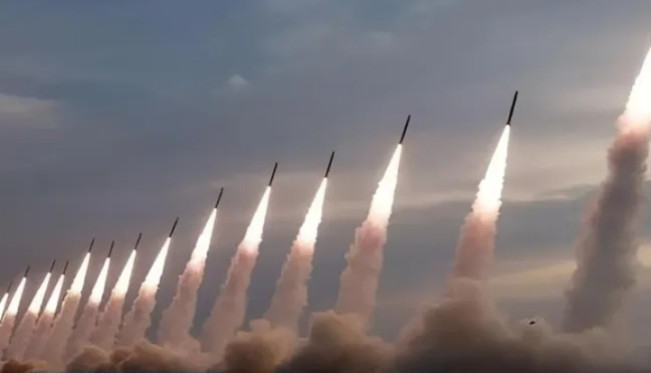
As the planet warms at alarming speed, glaciers melt, coastlines vanish, and wildfires choke cities in smoke, humanity faces a stark truth: we are at war with our environment—and we are losing. Now, with Israel and Iran engaged in open warfare, a second, more literal war threatens to derail any chance we have of winning the first.
This is not just a geopolitical showdown. It is a climate catastrophe, an economic tinderbox, and a moral failure unfolding in real time. As journalist David Wallace-Wells warned in The Uninhabitable Earth, “It is worse, much worse, than you think.” The Israel-Iran conflict proves that war is no longer a national issue. It is a planetary one.
Military conflicts are rarely discussed in climate policy, but they should be. According to a 2025 report by the Conflict and Environment Observatory, NATO’s expanded rearmament strategies could emit up to 194 million metric tons of CO₂ annually—equivalent to the emissions of an industrialized nation like the Netherlands. Despite this, military emissions are still largely exempt from international climate agreements, protected by outdated national security clauses.
In the case of Israel and Iran, the carbon footprint is already massive. Israeli airstrikes on Iranian nuclear and oil facilities have sparked fires releasing toxic pollutants into the air. Retaliatory missile strikes have targeted shipping hubs and refineries in the Gulf, generating thousands of tons of CO₂ and risking spills that could devastate the marine ecosystem. Fires at Iran’s Kharg Island oil terminal alone released enough carbon to rival the annual emissions of a small city.
These are not abstract statistics. They represent real consequences: poisoned water systems, destroyed farmland, and millions more displaced just as the climate crisis intensifies. In Gaza, the 2023 war generated an estimated 650,000 tons of CO₂ emissions in just two months. Experts now say that rebuilding the territory could produce 29 million more—nearly double the annual emissions of Iceland.
Meanwhile, the economic shockwaves are spreading. Israel is spending up to $200 million a day on its military operations. Iran’s oil exports—critical to its economy—have plummeted under attack. The global energy market, already strained by supply chain disruptions and climate-related disasters, has seen Brent crude prices spike over 11% since the conflict began. The Strait of Hormuz, through which 20% of the world’s oil supply flows, sits on a knife’s edge. Any blockage there could push global inflation to levels not seen since the pandemic.
Why U.S. Involvement Would Be a Grave Mistake
Amid this chaos, calls are growing for U.S. military involvement. But this would be a monumental mistake.
U.S. intervention would escalate the conflict beyond containment. Iran has threatened retaliation against U.S. bases, Gulf allies, and global shipping routes. A wider war would invite cyberattacks, proxy battles in Lebanon, Iraq, and Syria, and potentially even missile strikes on Israel’s allies. Worse still, it would put American forces in direct conflict with another sovereign military in a volatile nuclear region.
From a climate standpoint, the damage would be devastating. The Costs of War Project at Brown University estimates that U.S. military operations in Iraq and Afghanistan produced over 1.2 billion metric tons of greenhouse gases. Another prolonged campaign would add tens of millions more at a time when the U.S. should be leading the global energy transition—not bombing oil fields.
Economically, war would siphon billions from essential domestic investments. The Biden administration’s Inflation Reduction Act was designed to supercharge green energy and climate resilience. But those goals will be impossible to meet if new wars dominate the federal budget. Every missile fired in the Middle East is money not spent on wildfire defense in California, flood control in Florida, or clean water in Flint.
Politically, U.S. involvement would destroy its climate credibility. How can Washington advocate for a fossil fuel phaseout at COP30 while launching airstrikes that ignite oil fields? As Wallace-Wells reminds us, “Climate change is not a distant threat. It is an all-encompassing crisis reshaping everything we do.” That includes foreign policy.
We are entering an era where peace must be treated as climate strategy. War is not just a failure of diplomacy—it is a failure of environmental policy, public health, and economic foresight. The Israel-Iran conflict demonstrates that in today’s interconnected world, no war is isolated. Every explosion reverberates through oil prices, carbon emissions, refugee flows, and agricultural markets.
Choose Cooperation Over Catastrophe
To secure a livable future, global leaders—especially in Washington—must act with restraint. Instead of entering another war, the U.S. should focus on brokering ceasefires, delivering humanitarian aid, and funding green infrastructure at home and abroad. Climate stability cannot be achieved through conquest. It requires cooperation, compassion, and above all, peace.
The war we need to fight is not with Iran or Israel. It is with rising seas, failing crops, and a warming Earth. And the only way to win it is to stop fighting each other.
References:
- Wallace-Wells, David. The Uninhabitable Earth: Life After Warming. Penguin Random House, 2019.
- Conflict and Environment Observatory (2025). NATO Military Emissions Report.
- Costs of War Project, Brown University. “Environmental Costs of the Post-9/11 Wars.”
- The Guardian, AP News, and Financial Times reporting on Israel-Iran conflict (2025).
- Centre for Economics and Business Research, “Economic Risk of Strait of Hormuz Disruption” (2025).
