

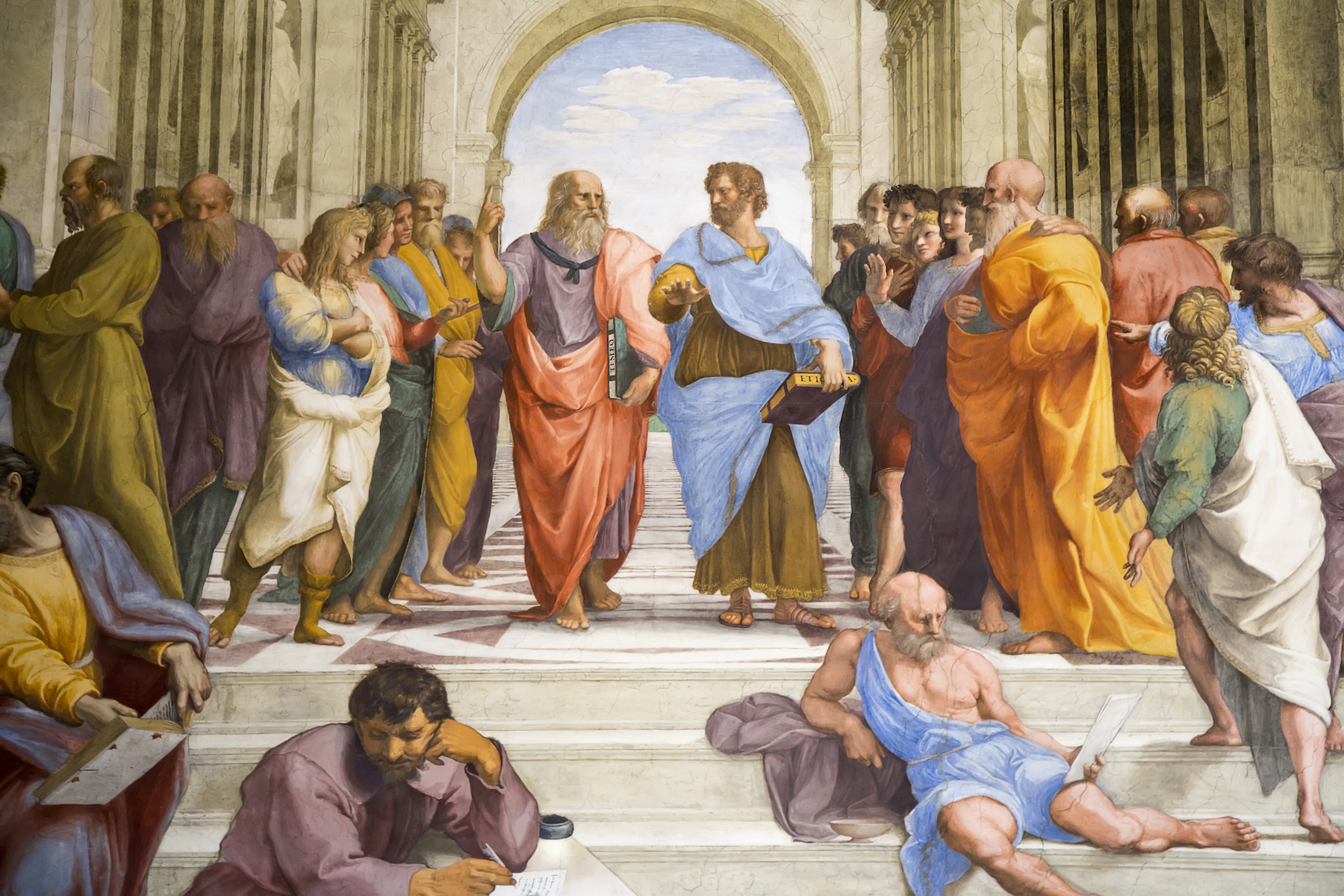
1. Socrates (470–399 BCE)
Socrates, often regarded as the father of Western philosophy, was an ancient Greek philosopher whose ideas laid the foundation for much of modern ethical and epistemological thinking. He did not leave behind any written works, but his philosophy has been passed down primarily through the writings of his students, most notably Plato and Xenophon. Socrates is best known for developing the Socratic Method, a form of cooperative argumentative dialogue that encourages participants to question their own assumptions and seek deeper understanding.
His method, often involving asking questions to guide people to their own insights, was revolutionary because it shifted the focus of philosophical inquiry from mere acceptance of established norms to a search for truth through critical thinking. Socrates believed that virtue was knowledge and that individuals could only live a good life by understanding and practicing virtue. His belief that “the unexamined life is not worth living” encapsulates his dedication to self-awareness and moral inquiry.
Socrates also questioned the traditional Greek views on gods, ethics, and knowledge. His criticisms of Athenian society, especially his challenge to the powerful elite, led to his trial and execution in 399 BCE. Accused of corrupting the youth and impiety, Socrates chose death over renouncing his philosophy, further solidifying his position as a martyr for truth and wisdom. His death marked a critical turning point in the relationship between philosophy and political power, influencing not only Greek thought but also Western philosophical tradition.
Though Socrates did not leave behind written texts, his influence has been enormous. His methods of dialectical reasoning and moral inquiry laid the groundwork for subsequent philosophers and thinkers, from Plato and Aristotle to contemporary philosophers who continue to emphasize critical thinking and ethics in education.
2. Plato (428–348 BCE)
Plato, a student of Socrates, is one of the most influential figures in Western philosophy. He founded the Academy, the first institution of higher learning in the Western world, and wrote extensively on subjects ranging from ethics and epistemology to political theory and metaphysics. Plato’s dialogues, in which Socrates is often the central figure, explore philosophical concepts in a manner that is both systematic and thought-provoking.
Plato’s theory of the Forms or Ideas is one of his most famous and controversial contributions. According to this theory, the material world is an imperfect reflection of a higher, eternal, and unchanging reality, which can only be apprehended through reason and intellect. For instance, concepts like beauty, justice, and goodness exist independently of our perceptions and are only truly understood in their idealized forms. This notion laid the groundwork for idealism, a central theme in the history of philosophy.
In addition to his metaphysical views, Plato’s political philosophy, especially in his work The Republic, has been foundational. In this text, Plato argues for a just society led by philosopher-kings—rulers who possess the wisdom and knowledge to govern fairly. His vision of an ideal state, where each individual plays a role suited to their nature, influenced political thought for centuries, from ancient Greece through to the Renaissance and the Enlightenment. The Platonic ideals of justice, equality, and wisdom have inspired political movements and are embedded in discussions of governance today.
Plato’s impact on education, metaphysics, ethics, and political theory remains profound. His exploration of the nature of knowledge and truth continues to shape philosophical thought, and his works are essential reading for anyone studying the history of Western philosophy.
3. Aristotle (384–322 BCE)
Aristotle, a student of Plato, made profound contributions to nearly every field of philosophy and science, making him one of the most influential figures in Western intellectual history. His works span a vast array of subjects, including ethics, metaphysics, political theory, logic, biology, and poetics. Aristotle’s empirical approach to philosophy led him to challenge the more abstract theories of Plato, and his belief in the importance of observation and experience as sources of knowledge set the foundation for the scientific method.
In ethics, Aristotle’s Nicomachean Ethics outlines his vision of the good life, focusing on the concept of eudaimonia (flourishing or well-being). According to Aristotle, the goal of human life is to achieve happiness, which can only be attained through the practice of virtue. Virtue, for Aristotle, is about finding the balance between deficiency and excess—what he called the Golden Mean. This idea remains influential in contemporary discussions of morality and ethics.
Aristotle’s political theory, as presented in Politics, advocates for a balanced form of government, one that avoids the extremes of tyranny and anarchy. He believed that the best society is one in which the citizens live virtuous lives, and the government serves the common good. Aristotle’s concept of the best government and his idea of justice continue to be central to political philosophy today.
Aristotle also made groundbreaking contributions to logic, developing the system of syllogism—a method of deductive reasoning that is still taught in modern logic courses. In biology, he made significant strides by categorizing and studying animals and plants, laying the groundwork for later developments in the biological sciences.
Through his work, Aristotle shaped not only ancient Greek thought but also the medieval scholastic tradition, influencing philosophers like Thomas Aquinas. His integration of philosophy with science laid the foundation for modern natural sciences and remains a cornerstone of philosophical education.
4. René Descartes (1596–1650)
René Descartes, a French philosopher and mathematician, is often regarded as the father of modern philosophy. His method of radical doubt and emphasis on reason as the path to certainty revolutionized how philosophers approached knowledge and existence. Descartes famously said, Cogito, ergo sum (“I think, therefore I am”), which became the cornerstone of his epistemology. By doubting everything that could be doubted, Descartes concluded that the very act of doubting proved the existence of the self as a thinking being.
Descartes’ dualism, the idea that the mind and body are separate substances, is another of his most influential contributions. In his work Meditations on First Philosophy, he argued that the mind is distinct from the body and that mental processes are not bound by the same physical laws that govern the material world. This idea laid the foundation for later developments in psychology and philosophy of mind.
In addition to his philosophical work, Descartes made significant contributions to mathematics, developing analytic geometry and contributing to the development of the Cartesian coordinate system, which has had a lasting impact on geometry and calculus.
Descartes’ influence extends beyond philosophy into science and mathematics, where his emphasis on skepticism and empirical observation influenced the development of the scientific method. His philosophical exploration of the mind-body relationship remains a central topic in modern debates in both philosophy and neuroscience.
5. Immanuel Kant (1724–1804)
Immanuel Kant is one of the most significant figures in modern philosophy, particularly in the fields of epistemology and ethics. His work sought to reconcile the rationalist and empiricist traditions that had dominated philosophy. In Critique of Pure Reason, Kant proposed that human experience is shaped both by the data we receive through our senses and by the inherent structures of the mind. This view, known as transcendental idealism, argues that while we cannot know things as they are in themselves, we can know the phenomena they present to us.
Kant’s moral philosophy, as laid out in the Groundwork of the Metaphysics of Morals, introduced the concept of the Categorical Imperative—an ethical guideline that states one should act only according to maxims that could be universally applied. Kant believed that morality is not based on the consequences of actions but on the intention behind them. His emphasis on autonomy and rationality has had a lasting influence on modern ethics.
Kant’s philosophy also profoundly influenced political theory, particularly his views on human rights, freedom, and justice. His ideas provided a foundation for modern liberal thought, especially in the areas of democracy and human dignity.
Kant’s contributions to epistemology, ethics, and metaphysics continue to shape contemporary philosophical discussions, particularly in areas concerning the nature of reality, knowledge, and moral duty.
6. John Locke (1632–1704)
John Locke was an English philosopher whose contributions to empiricism and political theory profoundly shaped the development of modern philosophy and the Enlightenment. His major work, An Essay Concerning Human Understanding (1690), challenged the notion of innate ideas proposed by earlier philosophers like René Descartes. Locke argued that the human mind begins as a tabula rasa, or blank slate, and that all knowledge is derived from experience. This idea revolutionized epistemology by suggesting that knowledge is not something innate, but something that develops through sensory experience and reflection. Locke’s theory of knowledge has had a lasting influence on the fields of psychology and education, emphasizing the role of environment and experience in shaping an individual’s mind.
Locke’s political philosophy, articulated in Two Treatises of Government (1689), was similarly groundbreaking. In this work, Locke formulated his theory of the social contract, which proposed that governments derive their legitimacy from the consent of the governed. According to Locke, individuals possess natural rights to life, liberty, and property, and the primary role of government is to protect these rights. If a government fails to do so, Locke argued that the people have the right to overthrow it. His views on the rights of individuals and the limitations of government were incredibly influential, laying the intellectual foundation for modern liberal democracy.
Locke’s ideas had a significant impact on both the development of democratic thought and the formation of political institutions. His influence can be seen in the American Revolution, where his ideas on natural rights helped shape the U.S. Declaration of Independence. Locke’s work also had a profound impact on the drafting of the U.S. Constitution, especially regarding the protection of individual freedoms and the system of checks and balances. His emphasis on empiricism and the importance of freedom continue to influence philosophical, political, and educational thought to this day.
7. Thomas Hobbes (1588–1679)
Thomas Hobbes was an English philosopher best known for his contributions to political philosophy. His most influential work, Leviathan (1651), is a cornerstone of social contract theory. In this text, Hobbes presents a pessimistic view of human nature, arguing that in the state of nature—without the structure of government—humans are driven by self-interest, leading to a chaotic and violent existence. He famously described this condition as the “state of nature”, where life would be “solitary, poor, nasty, brutish, and short.” Hobbes believed that in order to avoid such chaos, individuals must surrender their rights to a powerful, centralized authority—a sovereign—which he referred to as the Leviathan.
For Hobbes, the social contract was not about creating a democratic government but rather about ensuring peace and security through absolute authority. The people’s surrender of their individual freedoms was necessary for the maintenance of order. His view that a strong ruler—whether a monarchy or a collective body—was essential for preserving peace was revolutionary at the time and laid the groundwork for modern realist political theory.
Hobbes’ ideas on governance and human nature had a profound impact on later political theorists and philosophers. His work influenced thinkers like John Locke, who disagreed with Hobbes on the nature of human rights and government. Hobbes’ theories also shaped the study of international relations, particularly the notion of power dynamics and the necessity of strong authority to maintain order in society. While his view of human nature as inherently selfish is often criticized, Hobbes’ work remains an essential contribution to the history of political thought, especially in the context of discussions on the nature of power, authority, and governance.
8. Jean-Jacques Rousseau (1712–1778)
Jean-Jacques Rousseau was a French philosopher whose ideas on political theory, education, and society have had a profound impact on modern philosophy, particularly in the areas of democracy and equality. Rousseau’s most famous work, The Social Contract (1762), introduces the concept of the general will, the collective will of the people that aims to promote the common good. Rousseau famously declared, “Man is born free, and everywhere he is in chains,” criticizing the social structures that restrict individual liberty and promote inequality. His theory of the general will suggested that a legitimate government must reflect the will of the people, not the will of a monarch or aristocracy. This concept of popular sovereignty influenced revolutionary movements, particularly the French Revolution, where the idea of the people’s power to create a just society became central.
Rousseau’s views on education, expressed in Emile (1762), also had a lasting influence. In this work, he emphasized the importance of nurturing a child’s natural curiosity and capacity for independent thought. Rousseau advocated for an education system that focused on developing the whole person, allowing children to explore their own interests rather than imposing a rigid curriculum. This approach influenced the development of modern educational philosophy and pedagogy.
Rousseau’s critique of inequality and social injustice, as well as his ideas on direct democracy, continue to shape contemporary political thought. His emphasis on the freedom of individuals and his belief that society must be built on principles of equality and justice have inspired various movements aimed at achieving political and social reforms. Rousseau’s ideas also laid the groundwork for later Marxist theories on class struggle and social change, making him a central figure in the intellectual history of both the Enlightenment and the development of socialist thought.
9. Friedrich Nietzsche (1844–1900)
Friedrich Nietzsche was a German philosopher who is widely regarded as one of the most influential thinkers of the 19th century. Nietzsche’s work challenged traditional moral and religious values, particularly through his declaration that “God is dead.” This statement symbolized the decline of traditional Christian values and the rise of secularism in the modern world. Nietzsche believed that the loss of faith in religion would create a crisis of meaning, but he also saw this as an opportunity for individuals to define their own values and purpose in life.
Nietzsche’s concept of the Übermensch (or Superman) described an individual who transcends conventional morality and societal constraints to create their own path. The Übermensch represents a new ideal of human existence, one that embraces the will to power, creativity, and self-overcoming. Nietzsche’s exploration of master-slave morality highlighted the distinction between the values of the ruling elite, who create values based on strength and power, and the oppressed, whose values are shaped by weakness and resentment. Nietzsche believed that overcoming these constraints would lead to the development of a more powerful and authentic individual.
Nietzsche’s work on the will to power as the driving force of human behavior has had a profound impact on existentialism, postmodernism, and psychology. His critique of traditional morality and his call for the reevaluation of values influenced thinkers like Jean-Paul Sartre, Michel Foucault, and Carl Jung. Nietzsche’s ideas about individualism, self-creation, and the search for meaning continue to resonate in contemporary philosophical, cultural, and psychological discussions.
10. Martin Heidegger (1889–1976)
Martin Heidegger was a German philosopher whose work in phenomenology and existentialism fundamentally changed the way we think about Being. His most influential text, Being and Time (1927), explores the nature of existence and our relationship to the world. Heidegger argued that modern individuals are alienated from an authentic experience of existence due to their focus on material concerns and technology. In his view, modern people live in a state of inauthenticity, disconnected from the deeper truths of existence.
Heidegger’s concept of being-toward-death is one of the central ideas in his philosophy. He believed that by confronting our own mortality, we can live more authentically and fully. Recognizing that our time is finite encourages us to take ownership of our lives and make meaningful choices. Heidegger’s focus on authenticity challenges individuals to reflect on their existence and embrace the inherent uncertainty and complexity of life.
Heidegger also explored the role of language in shaping human experience and understanding. He believed that language is not just a tool for communication but a medium through which we relate to and interpret the world. His work in hermeneutics, the theory of interpretation, has had a significant impact on the fields of literary theory and philosophy of language.
Heidegger’s influence extends to a wide range of disciplines, including existentialism, post-structuralism, literary theory, and critical theory. His exploration of the nature of Being, language, and human existence continues to shape contemporary debates on human subjectivity, the role of technology, and the future of philosophy.
11. David Hume (1711–1776)
David Hume was a Scottish philosopher who made significant contributions to the fields of empiricism, skepticism, and ethics. His work laid the foundation for modern psychology and cognitive science, particularly with his exploration of the human mind and the nature of knowledge. In his seminal work, A Treatise of Human Nature (1739-1740), Hume argued that all human knowledge arises from sensory experience and that the mind operates by associating ideas formed through these sensory experiences. Hume’s emphasis on experience over abstract reasoning challenged the rationalist tradition, particularly the views of philosophers like René Descartes.
One of Hume’s most famous philosophical positions is his problem of causality. He argued that we cannot observe causality directly and that our belief in cause-and-effect relationships is a result of habit or custom, not rational deduction. According to Hume, we can never truly know the nature of the external world or establish certain knowledge about it; instead, we only have perceptions of it, which are subject to change. This radical skepticism about the limits of human knowledge has had a profound impact on later philosophy, especially in epistemology and the philosophy of science.
Hume’s exploration of ethics also challenged traditional moral philosophy. He rejected the idea that reason alone could determine moral judgments, arguing instead that our moral feelings are driven by our emotions and sentiments. In A Treatise of Human Nature, he famously argued that “reason is, and ought only to be the slave of the passions,” emphasizing the role of human psychology in moral decision-making. His work on ethics contributed significantly to the development of sentimentalism, which holds that moral values are rooted in human emotions and feelings rather than objective rational principles.
Hume’s skepticism, especially regarding the existence of self as a permanent identity and his views on induction, continues to influence contemporary philosophy, psychology, and the philosophy of science. His empirical approach to understanding the mind laid the groundwork for later developments in behaviorism and cognitive psychology. His ideas about human nature and the limitations of human understanding also shaped modern epistemology, especially in the context of empiricism and the scientific method.
12. Georg Wilhelm Friedrich Hegel (1770–1831)
Georg Wilhelm Friedrich Hegel was a German philosopher who had a profound impact on the development of idealism and dialectical reasoning. His work in absolute idealism and the dialectical method deeply influenced later thinkers, including Karl Marx, Existentialists, and critical theorists. Hegel’s dialectical method posits that history and reality evolve through contradictions, with each stage of development (thesis) being opposed by its negation (antithesis), ultimately leading to a new synthesis that incorporates elements of both. This process of thesis-antithesis-synthesis represents the unfolding of history and the development of human freedom and self-consciousness.
In Hegel’s magnum opus, The Science of Logic (1812–1813), he argued that reality is the manifestation of an evolving absolute idea. For Hegel, the material world is not an independent existence but rather a reflection of the unfolding of this absolute idea. This notion of an evolving, self-conscious reality challenges the more static, mechanistic view of the world promoted by earlier philosophers such as Descartes and Locke.
One of Hegel’s central concerns was the nature of self-consciousness. In Phenomenology of Spirit (1807), he explored the process by which individuals become aware of themselves through their relationship with others. This development of self-consciousness is a key part of Hegel’s broader understanding of freedom. According to Hegel, human freedom is realized when individuals come to understand their place in the broader historical and social context, as history itself progresses toward greater rationality and freedom.
Hegel’s work on the state and political theory in The Philosophy of Right (1820) influenced later thinkers like Karl Marx and Friedrich Engels, who critiqued Hegel’s idealism and applied the dialectical method to material conditions, leading to the development of historical materialism. Hegel’s ideas about the state and individual rights remain influential in political philosophy, with modern discussions of democracy, freedom, and social justice drawing on his concepts of ethical life and the integration of individual and collective rights.
Hegel’s complex system of dialectics, his ideas on freedom and history, and his view of reality as a dynamic, evolving process continue to shape contemporary thought, especially in fields such as political philosophy, history, and theory of knowledge.
13. John Stuart Mill (1806–1873)
John Stuart Mill was an English philosopher and political economist who played a key role in the development of utilitarianism, a moral theory that emphasizes the greatest happiness for the greatest number. Mill was a prominent advocate of individual rights, social reforms, and liberal democracy, and his work on ethics, liberty, and political philosophy has had a lasting impact on modern liberal thought.
In his most famous work, On Liberty (1859), Mill argued for the protection of individual freedoms against the tyranny of the majority and government overreach. He asserted that individuals should be free to act as they wish, provided they do not harm others. This principle, known as the harm principle, became a cornerstone of liberal political theory. Mill’s advocacy for personal autonomy and limited government was instrumental in shaping modern liberalism and in supporting movements for social reforms such as women’s rights and freedom of speech.
Mill’s utilitarianism, which he outlined in Utilitarianism (1863), is a form of ethical theory that states actions are morally right to the extent that they promote happiness and well-being. Mill refined the utilitarian philosophy originally developed by Jeremy Bentham by incorporating qualitative distinctions in pleasure, arguing that intellectual and moral pleasures are superior to physical pleasures. Mill’s version of utilitarianism has influenced ethical theory, political philosophy, and economics, particularly in discussions about social justice and policy-making.
In addition to his work in ethics, Mill was a strong advocate for social reforms, including the abolition of slavery, the promotion of women’s suffrage, and the extension of educational opportunities. His work on economic liberalism also had a significant impact on the development of classical economics and the study of free markets.
Mill’s contributions to libertarian thought, his advocacy for individual rights, and his utilitarian ethics continue to influence contemporary debates about social justice, human rights, and political freedom.
14. Karl Marx (1818–1883)
Karl Marx was a German philosopher, economist, and political theorist best known for his development of historical materialism and his critique of capitalism. Marx argued that human history is shaped by class struggle, with economic relations at the core of social development. In his most famous works, The Communist Manifesto (1848) and Das Kapital (1867), Marx developed his theory of historical materialism, which posits that economic structures and class relations drive historical change.
Marx’s analysis of capitalism focused on its inherent contradictions and the exploitation of the working class, or proletariat, by the owning class, or bourgeoisie. He argued that capitalism is inherently unstable and that it will eventually be replaced by a socialist and communist society, where the means of production are collectively owned, and class distinctions are abolished. Marx’s revolutionary ideas inspired socialist movements worldwide and had a profound influence on the development of Marxist theory, socialism, and communism.
Marx’s contributions to economics were also groundbreaking. In Das Kapital, he analyzed the dynamics of capital accumulation, the role of labor in the production process, and the nature of surplus value, the value extracted from workers in the form of profit. His theories of value, labor, and exploitation laid the foundation for much of Marxist economics and continue to influence contemporary debates about economic inequality, labor rights, and the critique of capitalism.
Marx’s revolutionary ideas about the relationship between economics, class struggle, and historical change have had a profound impact on political theory, sociology, and economics. His theories have been applied to analyze capitalist societies and have inspired numerous socialist and communist revolutions throughout history.
15. Baruch Spinoza (1632–1677)
Baruch Spinoza was a Dutch philosopher known for his development of a rationalist system of philosophy, which emphasized the role of reason in understanding both the natural world and the human mind. Spinoza’s work on pantheism and determinism revolutionized philosophy and had a lasting impact on subsequent developments in ethics, metaphysics, and political theory.
In his most important work, Ethics (1677), Spinoza presented a monistic view of the universe, asserting that God and Nature are essentially the same. This idea, known as pantheism, implies that everything in the universe is interconnected and governed by the same laws of nature. Spinoza rejected the traditional conception of God as a personal, transcendent being and instead argued that God is the totality of existence. According to Spinoza, the universe operates according to a deterministic order, where everything, including human thoughts and actions, follows from the laws of nature.
Spinoza’s ideas about human freedom and ethics were also highly influential. He argued that true freedom is not the ability to act without constraints but the ability to act in accordance with reason. For Spinoza, the pursuit of reason leads to mental clarity, emotional balance, and ultimately human well-being. His ethical system emphasizes that understanding the natural world and our place within it leads to self-realization and peace of mind.
Spinoza’s ideas about ethics, determinism, and pantheism influenced later philosophers such as Hegel, Nietzsche, and Einstein, who appreciated his ideas on the interconnectedness of all things. His rationalist approach to understanding the universe and his emphasis on reason continue to shape debates in philosophy, science, and theology.
16. G.W.F. Hegel (1770–1831)
Georg Wilhelm Friedrich Hegel was a German philosopher whose ideas revolutionized idealism and dialectics, laying the groundwork for a significant part of modern philosophy. Hegel’s complex system of dialectical reasoning posited that historical and intellectual progress occurs through a process of thesis, antithesis, and synthesis. This dynamic triadic process is the method by which contradictions or conflicts (thesis and antithesis) are resolved into a higher, more developed synthesis, which then becomes the new thesis for further development. For Hegel, this process applied not only to abstract philosophical concepts but to all of history and reality itself. According to Hegel, history is not a random series of events but a rational process leading to greater freedom and self-awareness.
One of the cornerstones of Hegel’s philosophy is his concept of absolute idealism. In works such as The Science of Logic and The Phenomenology of Spirit, Hegel argued that reality is fundamentally mental or spiritual in nature. He believed that everything in the world is a manifestation of an underlying, evolving absolute idea that seeks to realize itself through history. For Hegel, the ultimate goal of history is the development of human freedom through the unfolding of self-consciousness, with Spirit (Geist) being the key force driving this process.
Hegel’s philosophy of self-consciousness emphasizes the importance of recognition in the development of individual identity. In Phenomenology of Spirit, Hegel introduces the concept of the master-slave dialectic, in which self-consciousness emerges through conflict, as one consciousness seeks recognition from another. This idea not only influenced later philosophers such as Karl Marx but also had a profound impact on existentialism, Marxism, and critical theory.
Hegel’s ideas on the state and ethics also shaped political theory. In The Philosophy of Right, he argued that the state represents the realization of human freedom, as individuals find their true identity within the ethical life of the community. His emphasis on the importance of the state, civil society, and the individual’s role within these structures provided a foundation for later political thinkers, especially in relation to questions of liberty, equality, and democracy.
Overall, Hegel’s influence extends far beyond philosophy, shaping political theory, historical materialism (via Karl Marx), existentialism, and even the development of modernism. His dialectical method remains central to philosophical thought in the 21st century, particularly in understanding the dynamics of history, culture, and society.
17. Søren Kierkegaard (1813–1855)
Søren Kierkegaard, a Danish philosopher, is widely regarded as the father of existentialism, a philosophical movement that emphasizes individual subjectivity, freedom, and personal choice. Kierkegaard’s focus on the self, personal responsibility, and the leap of faith marked a significant departure from traditional philosophy and theology. His work explores themes of anxiety, despair, and the authentic self, influencing later thinkers such as Friedrich Nietzsche, Jean-Paul Sartre, and Martin Heidegger.
In his most famous work, Fear and Trembling (1843), Kierkegaard explores the concept of the leap of faith, a key idea in his philosophy. He argued that faith is not something that can be rationally understood or proven; rather, it involves a passionate, personal commitment to God, which requires overcoming doubt and uncertainty. This leap of faith becomes a symbolic expression of the individual’s existential struggle between reason and faith, representing a profound choice that transcends mere intellectual belief.
Kierkegaard also critiqued the notion of a universal morality or a systematic philosophy of life that ignores the individual’s personal experience and relationship with God. His work on subjectivity emphasized that truth is not an abstract, objective principle but is deeply intertwined with the lived experience of the individual. In his book The Sickness Unto Death (1849), Kierkegaard delves into the concept of despair, which he views as the result of failing to reconcile the self with its true purpose or identity. According to Kierkegaard, despair occurs when individuals fail to recognize their finite nature while trying to be something infinite, or when they fail to connect with the divine.
Kierkegaard’s exploration of Christian existentialism makes his work particularly significant in both theological and philosophical contexts. His emphasis on the individual’s relationship with God and the importance of personal choice has inspired Christian existentialists like Paul Tillich and Karl Jaspers, as well as non-religious existentialists like Jean-Paul Sartre.
Kierkegaard’s critique of systematic philosophy also led to his rejection of Hegelianism, the dominant philosophical system of his time, which he saw as a misguided attempt to reduce the complexities of human existence to abstract, impersonal concepts. Instead, Kierkegaard emphasized the importance of personal experience and individual responsibility. His exploration of anxiety, freedom, and subjectivity paved the way for the later development of existentialism as a philosophical movement.
18. Michel Foucault (1926–1984)
Michel Foucault was a French philosopher whose work focused on the relationship between power and knowledge. He explored how social institutions such as prisons, hospitals, and schools shape human behavior and social norms. Foucault’s interdisciplinary approach to philosophy, which combined history, sociology, psychology, and political theory, has had a profound influence on a wide range of disciplines, including sociology, political science, gender studies, and cultural studies.
One of Foucault’s most influential concepts is the idea of power-knowledge—the idea that power is not only something that is wielded by institutions or individuals but is also embedded in the production of knowledge. According to Foucault, knowledge and power are deeply interconnected, with institutions controlling knowledge and using it to shape societal norms, practices, and values. He explored this concept in his analysis of discourses (systems of knowledge) and how they regulate and control people’s behavior. In Discipline and Punish (1975), Foucault traced the development of disciplinary institutions and the ways in which modern societies have developed techniques of surveillance, normalization, and punishment to control individuals.
Foucault also examined how sexuality has been constructed and controlled by society, particularly in his influential work The History of Sexuality (1976–1984). In this work, he argued that sexuality is not a natural or biological fact, but a construct shaped by societal forces and institutions. He focused on how the regulation of sexuality is tied to broader social systems of power and governance. His exploration of how discourse shapes human behavior and identity has had a lasting influence on queer theory and feminist theory.
Foucault’s work on biopower—the way in which modern societies regulate populations through the management of life processes (such as health, reproduction, and education)—has also been highly influential in critical theory and postmodernism. His critique of traditional forms of power and his focus on the microphysics of power have provided valuable insights into how power operates in everyday life.
Foucault’s later work on ethics and care of the self, particularly in The History of Sexuality, Volume 3 (1984), shifted focus to the possibilities for personal freedom and resistance against dominant systems of power. He suggested that individuals could resist domination through a care of the self, where one practices self-reflection and self-transformation.
Foucault’s ideas continue to shape contemporary debates in social theory, political philosophy, and critical theory, particularly in discussions about power, surveillance, and the relationship between individuals and institutions.
19. Jean-Paul Sartre (1905–1980)
Jean-Paul Sartre was a French philosopher and writer widely recognized as one of the central figures in existentialism. Sartre’s philosophy is based on the idea that existence precedes essence—that is, humans are not born with a predetermined nature or essence, but rather create their own meaning and values through their actions and choices. This radical freedom and responsibility form the cornerstone of his existentialist thought.
In his most famous work, Being and Nothingness (1943), Sartre explores the nature of human freedom, consciousness, and the concept of being-for-itself. Sartre contrasts human existence with the being-in-itself of objects, which simply exist without self-awareness. Humans, however, are uniquely conscious of their existence and are condemned to be free. This freedom, while liberating, is also a source of anguish for Sartre, as individuals must take responsibility for their actions without relying on an external moral code or divine authority.
Sartre also introduced the concept of bad faith, a form of self-deception in which individuals lie to themselves to escape the anxiety of absolute freedom. For Sartre, bad faith occurs when individuals deny their freedom and responsibility by conforming to social roles or following external norms instead of embracing their authentic self. Sartre’s emphasis on authenticity and self-creation has had a profound impact on existentialism and phenomenology, influencing thinkers such as Simone de Beauvoir, Maurice Merleau-Ponty, and Albert Camus.
Sartre’s existentialism also extends into ethics and political philosophy. He argued that individuals are responsible not only for their own actions but for the collective fate of humanity, as their choices affect others. This leads to Sartre’s concept of engagement—the idea that intellectuals and individuals must take active roles in society and politics. His political activism, especially in support of Marxism, anti-colonialism, and human rights, reflects his commitment to freedom and responsibility on a societal scale.
Sartre’s existentialism, especially his emphasis on freedom, authenticity, and bad faith, remains central to discussions of human existence, moral philosophy, and political theory.
20. Bertrand Russell (1872–1970)
Bertrand Russell was a British philosopher, mathematician, and social critic who made profound contributions to analytic philosophy, logic, and the philosophy of language. Russell was a key figure in the development of modern logic and mathematical philosophy, particularly through his collaboration with Alfred North Whitehead in writing Principia Mathematica (1910-1913), a landmark work that aimed to establish a logical foundation for all of mathematics.
Russell’s work on logic and mathematics helped to lay the foundations for computer science, particularly in the development of formal languages and algorithms. He was also instrumental in the development of analytic philosophy, which emphasizes clarity of thought, logical analysis, and the importance of language in understanding philosophical problems. Russell’s logicism, the view that mathematics can be reduced to logical principles, was a major contribution to the philosophy of mathematics.
In addition to his work in logic and philosophy of language, Russell made significant contributions to epistemology and philosophy of mind. He was a leading figure in the development of logical positivism and empiricism, arguing that knowledge arises from sensory experience and logical analysis rather than metaphysical speculation. He was also an advocate for scientific reasoning and the application of logical methods to solve problems in a variety of disciplines.
Russell’s political activism was another important aspect of his life. He was a strong advocate for pacifism, human rights, and social justice. He campaigned against war, particularly World War I and Vietnam War, and promoted nuclear disarmament. His commitment to social issues, combined with his logical rigor and philosophical insights, made him a prominent figure in both intellectual and public life.
Russell’s contributions to philosophy, ethics, political theory, and social justice continue to influence contemporary debates on philosophy of language, political activism, and logical reasoning.
