


“We are a technology and knowledge savvy company.”
“Our most important strength is employees.”
“Our company has a good talent management program.”

Similar statements are increasingly heard in various articles, scientific journals, and management seminars. Corporate CEOs are competing to make claims that their employees are very important assets.
In fact, many employees do not feel treated as their most important assets. Their feelings are never understood, their opinions are neither heard nor valued, and their existence is not the company’s number one priority. Then, is that statement just rhetoric?
At the same time, the Covid-19 pandemic has left the world economy battered. It is certain, most industries are experiencing cash flow pressures today. As a result, companies rationalize even many to close. According to a South China Morning Post report, more than 460,000 companies in China have been recorded out of business.
The question is, are you sure that your organization is resilient enough to overcome the effects of this global pandemic?
Therefore, the authors put two prepositions as the basis to examine those two issues:
- There must be fundamental differences between companies that in their business strategies see employees as their most important assets, compared with companies that see money or technology as their traditional assets.
- The business continuity & recovery strategy during the Covid-19 pandemic can only be executed well by companies that realize that employee engagement is the key.
This paper is about anxiety sharing and the author’s experience of what has happened and is done at Aice Group Holding, Pte. Ltd., in his position as Head of Corporate HR.
Employee Engagement as the Key to Aice Group’s Success
Aice is an ice cream brand registered in Singapore in 2014. Aice Group has been operating in Indonesia since 2015, by acquiring PT. Alpen Food Industry (AFI), an ice cream factory in the MM2100 Region, Cibitung, Bekasi Regency, West Java. In addition to AFI, Aice Group also has its biggest factory, PT Aice Jatim Industry (AJI), in Ngoro Industrial Park, Mojokerto, East Java. With more than 140 distributor networks spread throughout Indonesia, Aice has controlled most of the general trade market share in Indonesia and has received a number of prestigious awards such as Top Brand, Super Brand, WOW Brand, Marketing Awards, and many others.
For competitors, Aice’s presence in Indonesia is a new phenomenon and a very serious business threat. How could it not be, not even 5 years of operation, Aice has captured more than 50% of the general trade market share, and now has also successfully entered the modern trade market with great confidence.
In addition to the successful differentiation of product strategies and marketing strategies, Aice also succeeded in formulating a human resource strategy that was made the main axis for the development of the overall business strategy, so as to produce strategic alignment as the key to its success.
From the very beginning of Aice Group, management realized the importance of putting the power of human resources as the main axis of business strategy. It is this perspective that enables Aice to penetrate the market quickly and effectively in all corners of Indonesia, in the middle of the game of giant competitors who have been operating for decades.

As a foreign investment company, Aice sees that the success of organizational performance happens because management focuses on specific business targets, which are executed through strategies that place the context of employee life (local culture, social values, humanitarian approaches, and regulatory norms in Indonesia). Thus, employees have a strong sense of ownership of the company, individual behavior and attitudes are engaged, optimal organizational commitment, so that each individual employee is able to contribute effectively and produce solid performance. In turn, it produces a strategic alignment that impacts on good and sustainable financial performance.
Pride to be part of a great organizational ecosystem, meaningful and valued feelings, and aware of opportunities to grow with companies are engineered, starting from the formulation of the company’s VMV which is translated through HR strategies that focus on job design, performance management and benefit alignment, leadership mindset, programs competency matrix based training, as well as employee relations activities with The Whole Person Paradigm approach (Covey, 2006) which focuses on meeting the needs of the mind, body, heart and soul of employees, so as to activate the optimal contribution of each individual and contextual working climate with way of thinking and lifestyle of millennial.
The Central Role of Employees in Facing the challenges of the Industrial Relations Crisis and the Covid-19 Pandemic
PT AFI is a company that was acquired by Aice in 2015. Despite many improvements in terms of system, employee benefits, job security, work environment health, and overall human resource management system, industrial relations problems with one of the hardliner union have always been a problem never finished. At present, 469 employees, who are members of the SGBBI union, are being laid off because of the provisions of the qualified law resigning due to an illegal strike. In addition, 74 other employees (from the same union) were also suspended because they are also in the middle of layoff processes due to the accumulation of Warning Letters.
This case arose not because the company was ignorant of legal norms. The company is very committed to complying with all statutory provisions in Indonesia, especially labor regulations. Evidenced by several visits by the West Java labor Supervisor Agency and the Ministry of Manpower Superintendent, there were no major violations found in the work safety and safety protection system and its human resource management system.
However, because of the element of external provocation, namely FSEDAR, a union federation (which is likely to be ridden by some interest parties), which is the parent organization of the SGBBI. They provoked union members to demand highly irrational wage increases. Even though the company has run the wage increase formula in accordance with the recommendations of the Bekasi Regency Manpower Office. Although bipartite negotiations and mediation were carried out repeatedly, but because of their unfulfilled desires, instead of registering rights disputes with the Industrial Relations Court, the union was indoctrinated to strike and was keen to report hoax news on social media, the aim of which was to damage the brand image and consumer trust in Aice.
Luckily, AFI still has more than 700 employees and 2 other unions who are furious and are disagree to the SGBBI irrational actions. AFI employees who are still working actually actively help management in solving this problem. Some of them forming a task force to make some internal improvements, motivating each other and strengthening fellow employees (because they experienced harassment from former qualified coworkers who resigned, both verbally, through social media, or physically), and helped management improve brand awareness on social media.
More than 700 social media contents are posted independently by employees every day. The contents raised are related to various CSR activities, employee activities, working environments, food creations with the main ingredients of ice cream, and other good news in order to increase Aice’s brand awareness. In addition, employees are also willing to become brand ambassadors by providing valid information about what the company is facing to those closest to them. The joint effort of all employees in supporting management to overcome the IR crisis and increase brand awareness during this pandemic is a form of employee attachment, which is also at the core of the strength of Aice’s resilience capability in times of crisis like this.
Developing Resilience Capabilities through the 3M Agenda
From the beginning, management realized that it would be impossible for Aice to compete with big competitors if it did not have strong differentiation. After conducting various researches, it was determined, the competitive advantage that could be the distinguishing element of Aice with its competitors was differentiated workforce (borrowing the term of Becker, 2009). Therefore, in order to place employees as the center of the company’s competitive advantage, HR management has an important role in formulating the company’s business strategy. HR Management realizes, if you want to prioritize human resources as a strategic axis, it is necessary to study the natural characteristics of humans, so that the strategic approach that will be carried out on target.
The results of the study categorize 3 fundamental characteristics of human resources compared to other resources, such as financial capital, machinery, technology, and raw materials (Gratton, 2000). First, that humans from time to time experience growth (Mastery). Humans grow in the past, present and future. Second, the history of human civilization proves that humans always get meaning from what they do and experience (Meaning). Humans always try to interpret the stimulus of the five senses, to know that their existence is needed and meaningful. Third, he needs to be part of something bigger than himself (Membership).
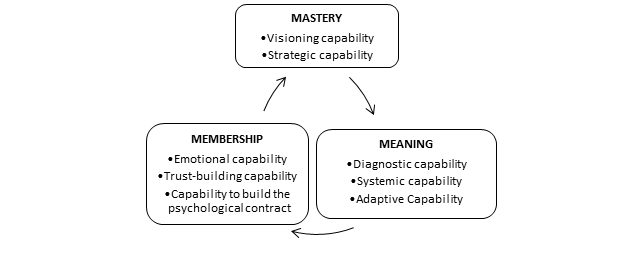
Thus, the human resource management strategy must focus on these 3 main agendas, so that organizational competences and employee attachment are realized which in turn fosters company resilience.
1. Mastery: Will to grow
“Temporality is clearly an organized structure, and these three elements of time: past, present, future, … are structured moments that build a synthesis.” – Jean-Paul Sartre, Being and Nothingness.
Sartre, a medieval existentialist philosopher, wants to say that the struggle of human life is characterized by three main things, namely memory and commitment from the past, current events, dreams and hopes for the future. The abilities and knowledge that we have today are obtained from what we experienced in the past and a picture of what will happen in the future.
Placing human resources at the center of the strategy requires that we have a view of the past, the ability to see the current situation wisely, a vision of a bright future and the ability to respond to changes over time. Therefore the company must be able to develop the following capabilities:
a. Visioning capabilities
The company’s capacity to create and develop a convincing and challenging vision of the future, and provides a real picture of the opportunities and threats that will occur and how we can win it.
b. Strategic capabilities
Creating a people-centered strategy is an organizational tool in balancing aspects of financial capital with human capital. The task of HR is to ensure that business targets can be realized with qualified organizational capabilities, performance evaluation systems and human resource competencies that are always honed.
2. Meaning: The will to seek meaning
Rene Descartes (French philosopher) in Discourse on Method (1637), wrote a very famous phrase, “Cogito Ergo Sum.” “I Think Therefore I am.”
Descartes wants to say that humans always think and search for meaning in every activity they want and have done. In companies, this search for meaning can be obtained through what is heard from superiors, how superiors and coworkers behave, what is discussed, as well as symbols contained in the work environment.
a. Diagnostic capabilities
To understand meaning, employees are not enough to be given an organizational structure, clear job descriptions, flow of responsibilities and reporting as well as other company policies. More than that, we must find out what each individual employee feels, what is considered important by them, what their aspirations are, what their motivations are and what factors are able to have a positive impact on them.
b. Systemic capabilities
Creating a sense of meaningfulness in organizations is quite complex. Therefore every process, policy, system, and all reality in the organization must be integrated and lead to clear organizational goals. This requires the ability of employees to think systematically, who see the organization as a whole, not just focus on certain areas.
c. Adaptive capabilities
Learning to adapt means building the capacity to innovate, both in an incremental and transformational manner. This ability must be based on a complete understanding of what happened in the past, present and future challenges.
3. Membership: The desire to be part of a bigger / more meaningful one
Unlike other resources, human resources have soul. We have hopes and aspirations, we can trust and commit to something bigger. Trust and commitment are what make employees want to contribute voluntarily.
a. Trust-building capabilities
The crucial aspect in building trust and commitment to the organization is how we treat employees fairly and follow the trend. Distributive justice must be reflected in every flow of the HR process, starting from recruitment, determining work targets, performance evaluation systems, rewards, training and development, and so forth. Of course the most effective approach is an approach that fits the millennial generation style.
b. Capability to build the psychological contract
Nurturing psychological contracts is fundamental to the ability of a leader. Leaders must be able to understand the needs of each individual employee and provide a view of what the organization can provide, both in the short and long term. Leaders must be able to see subordinates as a whole person paradigm and apply the principle of 4 Imperatives of A Great Leader (Covey, 2000), which inspires trust, clarify VMV and goals, aligns system, and optimizes the talent of subordinates. Therefore the Leadership Development program, including training and leadership assessment, are important company agendas that should not be missed.
In addition, skill training programs, career paths, promotion policies and employee relations activities must be well designed in order to foster sense of membership, security and pride in being part of an organization that provides enough space for self-actualization and self-development.
Learning from this case studies, it can be concluded that there are fundamental differences between companies that in their business strategies see employees as their most important assets, compared with companies that see money or technology as their traditional assets. Companies that focus on their employees will see employees as the main strength, so that human resource management policies and benefits to employees become the main priority.
Finally, the business continuity & recovery strategy during the Covid-19 pandemic can only be executed well by companies that realize that employee engagement is the key. For that the company must make concrete steps to ensure distributive justice and positive employee perceptions, so that employee commitment and attachment are maintained.
Bibliography
Gratton, Lynda (2000) “Living Strategy: Putting People at the Heart of Corporate Purpose,” Prentice Hall
Covey, Stephen M. R. (2006) “The Speed of Trust: The One Thing That Changes Everything,” Free Press
Becker, et al. (2009) “The Differentiated Workforce: Transforming Talent into Strategic Impact,” Harvard Business Press
Ulrich, Dave, et al. (2009) “Transformation: Building Human Resources from the Outside In,” RBL Institute

Apakabar Pak Antonius
LikeLike