

Jakarta, a city that pulses with energy and ambition, is defined by its chaos. The city’s streets are always busy, from the packed highways of Sudirman to the vibrant, buzzing cafés of PIK. People rush to their destinations, taxis honk in frustration, and motorbikes zip dangerously between lanes. This frantic pace has become a way of life in Jakarta, where everyone is trying to keep up, push ahead, and stay above water in a city that never stops moving.
But in the midst of all this hustle, Jakarta—and its people—are feeling the pressure. The very speed that once symbolized progress has become a source of stress. There’s a constant race for more—more wealth, more recognition, more influence. And yet, despite the outward success of its individuals, the city is grappling with deep challenges: traffic gridlocks, pollution, social inequality, and an increasing sense of alienation.
What if the solution isn’t to race faster, but to pause? To kneel, even in a city that encourages us to climb?
The Radical Gesture of Foot Washing
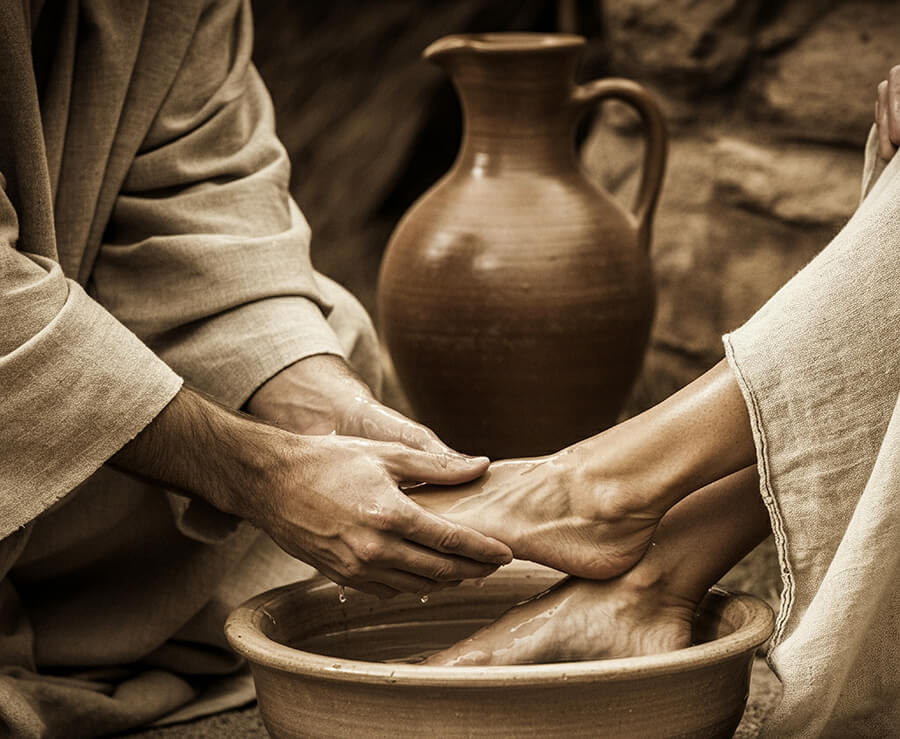
Every year on Holy Thursday, Christians around the world remember the last supper of Jesus Christ with His disciples. Amid the familiar rituals of breaking bread and sharing wine, there is one act that stands out: Jesus washing the feet of His disciples. It’s a moment that disrupts everything we think we know about leadership.
In a world where power, status, and control often define a person’s worth, Jesus’ decision to kneel and wash the feet of those He led is nothing short of revolutionary. At a time when His betrayal, arrest, and crucifixion loomed, Jesus—facing His own impending death—chose to serve rather than be served. He didn’t pick up a sword. He picked up a towel.
For Jesus, this was more than an act of humility; it was a direct challenge to the systems of pride, ego, and hierarchy that govern societies. He was showing that real greatness doesn’t come from rising above others; it comes from lowering oneself to serve them. It’s a message that is as disruptive today as it was 2,000 years ago.
Jakarta’s Ego-Driven Culture
In today’s Jakarta, the lessons of Jesus’ foot washing feel even more relevant. The city is often described as a place where personal ambition drives people to seek power, visibility, and control. We see this in the bustling business districts, in the political corridors, and even in the traffic jams that stretch endlessly across the city. It’s a survival game where the goal is to get ahead—at any cost.
In Jakarta, the unwritten rules are clear: the more you push, the more you rise. The louder you speak, the more you’re heard. The faster you go, the sooner you’ll get there. Whether in the workplace, the political sphere, or even on the road, it’s easy to get caught up in the “me first” mentality. The city’s pulse drives us to act out of self-interest, often without considering the impact on others.
But Jesus’ act of foot washing stands as a challenge to this culture. In a city where competition and individualism often reign, Jesus calls us to stop and reconsider what it means to be truly great. His actions suggest that greatness isn’t measured by how high we climb, but by how low we’re willing to go to serve others.
Foot Washing in the Modern World
Today, we may not be asked to literally wash someone’s feet, but the spirit of foot washing is still very much alive—and desperately needed in Jakarta. It doesn’t require grand gestures or public displays of sacrifice. It calls for humility in the small, often overlooked moments of our daily lives.
In Jakarta, this might look like letting someone merge into traffic without a fight, even when you’re running late. It could mean cleaning up a street corner that’s been littered by others, or taking the time to listen fully to someone’s concerns, rather than rushing to give your opinion. It could even mean acknowledging someone’s hard work in a meeting, even if they’re not in the room to hear it.
These acts may seem insignificant, but they reflect a deep, radical change in how we approach the world around us. They remind us that leadership isn’t about asserting dominance; it’s about elevating others. It’s about offering service over seeking recognition. It’s about creating space for others, rather than fighting for space ourselves.
The Challenges Facing Jakarta Today
In 2025, Jakarta faces serious challenges that can no longer be ignored. The city’s infrastructure is stretched thin, with traffic jams creating not only physical barriers but also contributing to an unhealthy air quality and an inefficient economy. Despite being one of the largest economic hubs in Southeast Asia, Jakarta remains plagued by stark inequality. The rich and poor live side by side, yet remain worlds apart. Social divisions are deepening, and a lack of empathy seems to have taken root.
One of the underlying causes of these problems is the culture of self-interest that drives much of the city’s behavior. Whether it’s the relentless drive for economic gain, the competition in the corporate world, or the relentless pursuit of status on social media, Jakarta’s people are often conditioned to place their personal goals above the common good.
But this isn’t just an issue unique to Jakarta—it’s a global one. In a world where ego, competition, and individualism often take precedence, cities like Jakarta are searching for something deeper, something that goes beyond performance and power.
The Call for Leaders Who Kneel
This is where the message of Holy Thursday, the day when Jesus washed His disciples’ feet, becomes a powerful antidote. Leadership in Jakarta, as in many places, is often associated with visibility, power, and control. But true leadership is not about climbing to the top of the ladder. It’s about getting down on your knees to help those who are struggling.
For those in leadership positions—whether in the government, corporate sector, or local communities—there is an urgent need to reimagine what leadership should look like. Leadership should not be about maintaining control or elevating oneself over others; it should be about empowering others, serving the community, and leading by example. True leaders are those who serve first, not those who demand to be served.
In Jakarta, where leadership is often confused with privilege, Jesus’ act of foot washing stands as a reminder: To lead is to kneel. Leaders who are willing to kneel for the sake of others—who put the needs of their community above their own—are the ones who can transform a city.
What Jakarta Needs Most
So, what does Jakarta need most in 2025? Smarter policies? Better infrastructure? Less traffic? Yes, those are all important. But at the core of many of the city’s challenges is a culture of ego-driven individualism. A lack of empathy for others. A failure to recognize the importance of serving, not just striving.
What Jakarta needs most is a shift in mindset. Not more people striving to climb higher, but more people willing to kneel lower. Not more selfish ambition, but more collective action. More empathy. More love.
Choosing the Towel
This Holy Thursday, as we reflect on the meaning of Jesus’ foot washing, let’s remember that this is not just a story from the past—it’s a blueprint for how we should live today. It challenges us to choose humility in a world that rewards ego. It calls us to prioritize others over ourselves, to listen before we speak, to serve before we demand.
In Jakarta, this may not be easy, but it is essential. To kneel in a city that teaches us to climb is not weakness; it is courage. It is leadership. It is the kind of action that can heal not only our hearts but our city as well.
Let this Holy Thursday be a reminder to choose the towel. Choose service over self-promotion. Choose love over power. And in doing so, let’s make Jakarta a city where greatness is measured not by how high we rise, but by how low we are willing to go to lift others up.
