

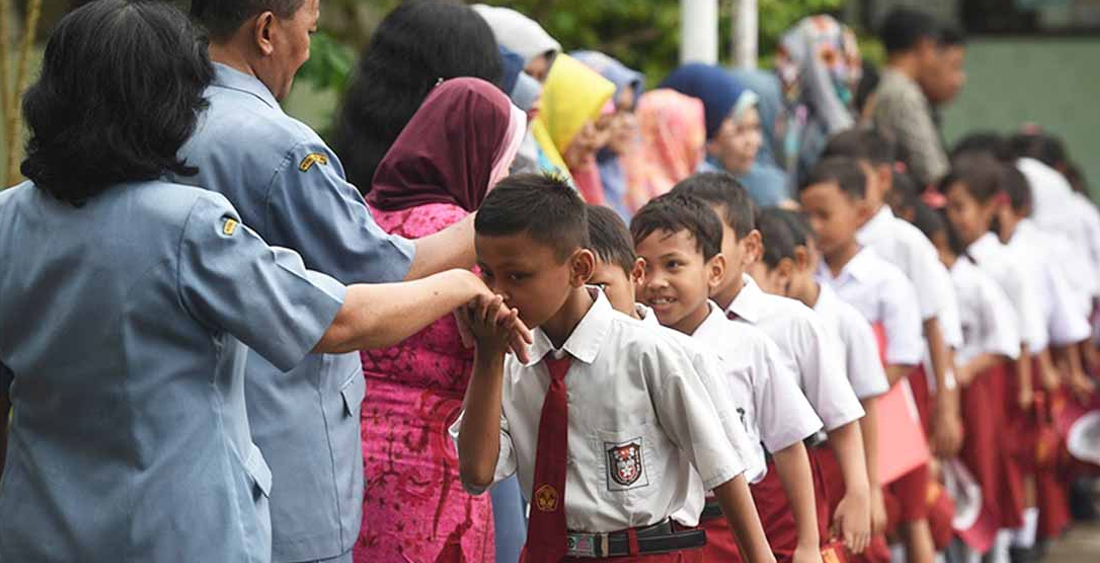
In Indonesia, hand-kissing has long been part of the culture as a form of respect for elders, such as parents, teachers, or community leaders. However, it is time to reconsider the relevance of this tradition in the modern era. Besides its respectful value, this practice also poses health risks that cannot be ignored.
As a symbol of respect, hand-kissing indeed holds strong cultural significance. However, with increasing awareness of hygiene and health, we must start questioning whether hand-kissing is still an appropriate form of respect, especially towards individuals outside the immediate family.
Health Risks of Hand-Kissing
Although it seems like a simple gesture, hand-kissing can be a medium for disease transmission. Direct physical contact between the hand and face increases the risk of contracting viruses or bacteria. Diseases such as flu, COVID-19, and other infections can easily spread through unclean hands. Research also shows that hands are among the most contaminated body parts due to frequent contact with various surfaces.
According to a study published by the Centers for Disease Control and Prevention (CDC), pathogens such as influenza and coronaviruses can survive on hands and surfaces for hours, increasing the likelihood of transmission through repeated contact (CDC, 2020). The World Health Organization (WHO) has also emphasized the importance of hand hygiene to prevent infectious diseases, highlighting the risks of unnecessary hand-to-face contact (WHO, 2021).
One tradition that deserves criticism is the practice of all students kissing their teacher’s hand when entering and leaving school. This is not only a burden on children but also a high-risk practice for disease transmission. Every student touches the same hand, which can become a breeding ground for germs and viruses. A 2020 study in the Journal of School Health found that shared physical contact among students and teachers significantly increases the spread of common respiratory infections (Jones & Smith, 2020). Furthermore, this tradition reflects a feudal master-servant relationship, where students are required to show absolute obedience to teachers in a way that is no longer relevant in modern times. In the post-pandemic era, schools should abandon this tradition and replace it with more hygienic forms of respect, such as bowing or placing a hand on the chest.
In the post-pandemic era, awareness of hand hygiene has increased significantly. According to a report by UNICEF, promoting hand hygiene in schools can reduce absenteeism due to illness by 40% (UNICEF, 2021). Therefore, the practice of hand-kissing should be discontinued, except for one’s parents. Instead, we can adopt more hygienic forms of respect, such as placing hands on the chest or simply bowing.
More Modern Forms of Respect
Several countries have long practiced more hygienic yet equally respectful forms of greeting:
- Malaysia and Brunei: Using a gesture with hands on the chest as a sign of respect.
- India: Using ‘namaste’ or ‘pranām’ by pressing both palms together at the chest and bowing the head.
- The Philippines: Using ‘mano po’ by placing the elder’s hand on the forehead, with minimal physical contact.
- Japan and Korea: Showing respect by bowing without physical contact.
A study published in Social Science & Medicine found that cultural gestures that minimize physical contact are just as effective in conveying respect while significantly reducing the risk of pathogen transmission (Tanaka & Lee, 2021). These traditions prove that respect does not always require physical contact. More modern and hygienic forms of respect can replace hand-kissing without diminishing its meaning and intent.
Hand-Kissing Ban in Saudi Arabia
Interestingly, in Saudi Arabia, hand-kissing is not only discouraged but has been officially banned by King Salman bin Abdulaziz. This prohibition aims to prevent the glorification of individuals and to show that respect can be given in simpler ways. According to an official statement from the Saudi royal court, the ban on hand-kissing aligns with Islamic teachings that discourage excessive veneration of individuals (Al-Faisal, 2020). This demonstrates that traditions are not unchangeable; we can adapt to evolving times and health needs.
Time to Stop, Except for Parents
Respecting parents is irreplaceable. Hand-kissing for parents can still be maintained as a symbol of love and filial piety. However, for others such as teachers, leaders, or public figures, we should transition to more modern and hygienic forms of respect.
As a continuously evolving society, we must dare to change traditions that are no longer relevant to current conditions. Abandoning the hand-kissing habit does not mean losing respect; rather, it shows concern for collective health and hygiene. Let’s start new and better habits without diminishing the essence of respect itself.
References
- Al-Faisal, H. (2020). Cultural Shifts in the Gulf: The Modernization of Traditional Practices. Riyadh: Kingdom Press.
- Centers for Disease Control and Prevention (CDC). (2020). Hand Hygiene and Disease Prevention. Atlanta, GA.
- Jones, R., & Smith, L. (2020). “The Role of Hand Hygiene in Reducing Disease Transmission in Schools.” Journal of School Health, 90(4), 321-334.
- Tanaka, Y., & Lee, K. (2021). “Social Gestures and Public Health: The Role of Contactless Greetings in Reducing Pathogen Transmission.” Social Science & Medicine, 285, 114267.
- UNICEF. (2021). Hand Hygiene in Schools: A Global Report on Health and Education. New York: UNICEF.
- World Health Organization (WHO). (2021). Guidelines on Hand Hygiene in Community Settings. Geneva: WHO.
