
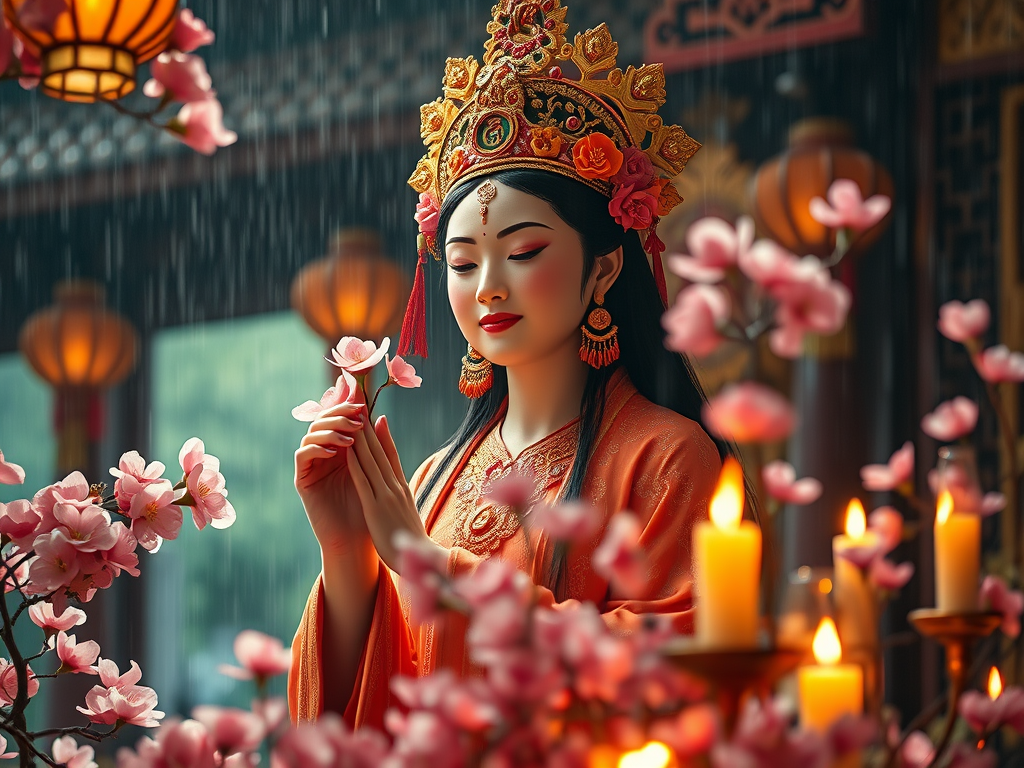
Dewi Kwan Im, also known as Guan Yin or the Goddess of Mercy, holds a cherished place in the hearts of Indonesian Chinese communities. She is believed to bless the Mei Hwa (plum blossom) and bring the life-giving rain during Chinese New Year, symbolizing renewal, hope, and abundance. For many, the rain is not just a natural occurrence but a divine embrace, a gentle reminder of the goddess’s compassion and care, washing away the burdens of the past year and nurturing the promise of a prosperous future.
The Mei Hwa, celebrated for its ability to bloom in winter, stands as a beacon of resilience and hope. Its delicate petals, surviving and thriving in the harshest conditions, mirror the enduring spirit of those who revere it. In the lore of Dewi Kwan Im, these blossoms are imbued with her blessings, and the rains that accompany their bloom are seen as her tender touch upon the earth. Every drop is thought to carry her mercy, bringing fertility to the soil, prosperity to families, and harmony to the community.
During Chinese New Year, temples dedicated to Dewi Kwan Im become vibrant sanctuaries of devotion and celebration. Adorned with flowers, incense, and offerings, these sacred spaces are filled with heartfelt prayers and the soft glow of candles. Families decorate their homes with branches of Mei Hwa, believing these blossoms channel the goddess’s blessings. When the rain falls during this season, it feels deeply personal—a divine affirmation of hope, a quiet moment of connection between the heavens and the earth. Communities gather, their hearts filled with gratitude, to honor the goddess’s presence and the promise of renewal she brings.
The rains of Chinese New Year hold profound meaning. They symbolize purification, gently washing away the sorrows and misfortunes of the previous year while preparing the way for new beginnings. This act of cleansing aligns seamlessly with the mythology of Dewi Kwan Im, whose essence is compassion and care. The rain not only nourishes the Mei Hwa but also serves as a metaphor for her nurturing spirit, a reminder of the interconnectedness of all life. It binds communities together, fostering unity and a shared reverence for the natural and spiritual worlds.
In Indonesia, these traditions are enriched by local customs. Prayers and chants invoking the rain are accompanied by offerings of flowers and incense, creating moments of serene beauty and heartfelt devotion. Traditional music and dances often add a uniquely Indonesian flavor to temple ceremonies, celebrating both the goddess and the blessings of rain. These practices highlight the adaptability of global myths, weaving them into the fabric of local culture and creating expressions that feel both timeless and uniquely personal.
Ultimately, the story of Dewi Kwan Im, the Mei Hwa, and the rain is more than mythology; it is a testament to the enduring power of compassion and hope. As communities welcome the rains and the blossoms each year, they are reminded of the goddess’s gentle guidance and the endless cycle of renewal. For the Indonesian Chinese community, these traditions are a source of comfort, a way to honor their heritage, and a celebration of the shared journey toward a brighter, more harmonious future.
