

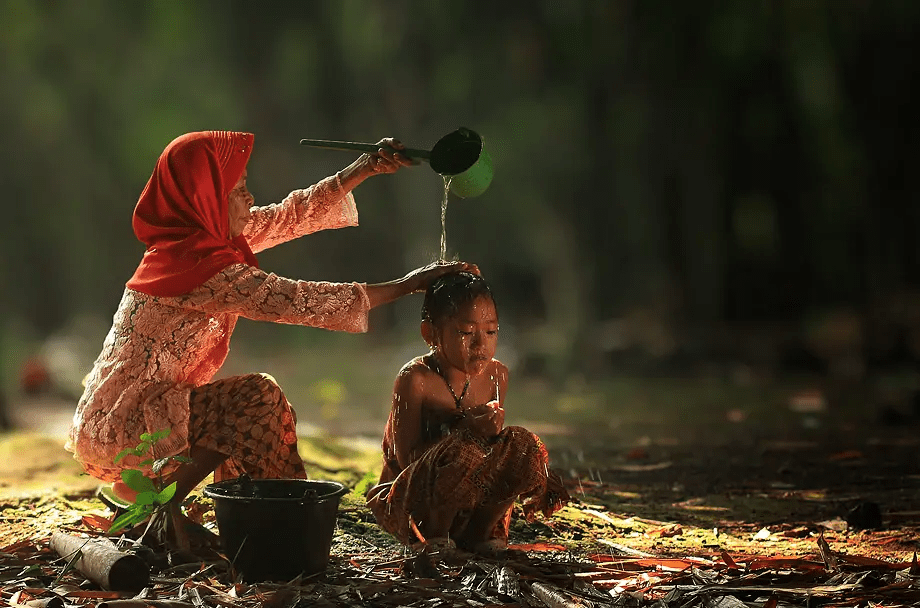
Tak lelo lelo lelo ledung
Cup menenga aja pijer nangis
Anakku sing ayu (bagus) rupane
Yen nangis ndak ilang ayune (baguse)
Tak gadang bisa urip mulyo
Dadiyo wanito (priyo) kang utomo
Ngluhurke asmane wong tuwa
Dadiyo pandekaring bangsa
Wis cup menenga anakku
Kae mbulane ndadari
Kaya butho nggegilani
Lagi nggoleki cah nangis
Tak lelo lelo lelo ledung
Enggal menenga ya cah ayu (bagus)
Tak emban slendang batik kawung
Yen nangis mundak ibu bingung
1. Spirituality
Tak-gadhang bisa urip mulya
Dadia wanita utama
Ngluhurké asmané wong tuwa
Dadia pendhékaring bangsa
The portrayal of spirituality in the Javanese song Lelo Ledhung is deeply intertwined with religious values expressed in its lyrics, which are rich with prayers. Each line carries a sense of hope and prayer for the child’s future. The phrase Tak-gadhang translates to “I hope,” representing a mother’s wishes for her child’s well-being. Bisa urip mulya means “to have a good life,” while dadio signifies “prayer” or “may you become.” The phrase wanita utama reflects the mother’s desire for her child to grow into a virtuous and successful woman. Furthermore, ngluhurké conveys the wish for the child to honor or elevate, while asmané wong tuwa refers to maintaining the good name of the parents. The word dadi again represents a prayer, “may you become,” and pendhékaring bangsa describes a “hero of the nation,” symbolizing someone who contributes positively to society.
These prayerful lyrics aim to express a mother’s hope that her child will grow into a good person (Tak-gadhang bisa urip mulya), honor the family name (Ngluhurké asmané wong tuwa), serve the country (Dadia pendhékaring bangsa), and become a valuable member of society (Dadia wanita utama).
2. Patience
Cup menenga, aja pijer nangis
Anakku sing ayu rupané
Yèn nangis ndhak ilang ayuné
Lelo Ledhung also beautifully illustrates the value of patience, particularly in how parents respond to a crying child. The repeated refrain cup menenga, aja pijer nangis appears at both the beginning and end of the song, reflecting the parent’s repeated effort to calm the child. Cup menenga means “please be quiet,” and aja pijer nangis means “don’t cry anymore,” with the parent trying to soothe the child. The line anakku sing ayu rupané is a compliment, meaning “my beautiful child,” which is intended to encourage the child to stop crying. The following line, Yèn nangis ndhak ilang ayuné, meaning “if you keep crying, your beauty will fade,” serves as a gentle reminder for the child to stop crying, reinforcing the earlier compliment.
These lyrics aim to convey a message of patience, as the parent calmly reassures the child, helping to instill peace through gentle words and a loving tone.
3. Affection
Tak-léla, léla, léla, lédhung
In Lelo Ledhung, the lyrics also convey a deep sense of affection from the parent to the child. This expression of love is a reminder that parents have a responsibility to care for their children with tenderness and devotion. Love is manifested not only in acts of kindness and education but also in providing a sense of peace and security. The line tak-léla, léla, léla, lédhung might seem nonsensical at first, but its meaning can be understood through its components. The word lela refers to “a gentle hand movement,” such as the act of rocking or cradling a child. Ledhung is a sound used to conclude a musical line, which has a soothing effect. Thus, Tak léla léla léla ledhung translates to “I will gently rock my dear child,” reflecting the mother’s affectionate act of cradling her child with love and care.
4. Wisdom
Tak emban slendang batik kawung
Yen nangis mundhak ibu bingung
The final section of Lelo Ledhung emphasizes the importance of wisdom, particularly in moral education. The motif of batik kawung, characterized by geometric patterns, symbolizes the balance between the heavenly, earthly, and spiritual realms. The four oval shapes with a central point represent unity among the people, nature, and beliefs, embodying harmony and balance. The use of the batik kawung motif, derived from the aren tree and lotus flower, underscores the connection between nature and wisdom.
The lyric tak emban slendang batik kawung signifies raising a child with love and wisdom, teaching them the importance of balance in life. The batik kawung motif suggests that parents should instill lessons about living a balanced life, integrating work, worship, community, and harmony between the worldly and spiritual aspects of life. Through this, parents hope that their children will grow up to lead a life filled with wisdom, guided by balance and harmony, both in this world and the afterlife.
Lelo Ledung beautifully reflects the deep and unconditional love of a mother, highlighting her hopes, patience, affection, and wisdom. The song portrays a mother’s nurturing role in shaping her child’s future and guiding them with love and care.
On Hari Ibu, celebrated every 22nd of December in Indonesia, we honor this selfless devotion that mothers offer. Just as the song wishes for a child’s well-being, success, and happiness, we take this day to appreciate the sacrifices and support that mothers provide. Hari Ibu serves as a reminder to cherish and thank our mothers for their endless love, which forms the foundation of who we are and everything we achieve. It is a day to celebrate their lasting impact on our lives and to express our gratitude for the care and wisdom they impart to us.
