


I recently revisited Stephen Covey’s The 8th Habit as part of my exploration into how we can redefine management in the context of modern society. In this work, Covey draws on the insights of Peter Drucker, one of the foremost thinkers on management, who offers a striking perspective on the future of humanity:
“In a few hundred years, when the history of our time is written from a long-term perspective, the most important event historians will recognize is not technology, not the Internet, not e-commerce. Instead, it will be an unprecedented transformation in the human condition. For the first time in history, large numbers of people have meaningful choices. For the first time, they must learn to manage themselves. And society is utterly unprepared for this reality.”
This powerful quote from Drucker, derived from his 1992 article in Harvard Business Review, underscores the fundamental shift we are experiencing as a society—one precipitated by the information age. We are moving from an era where management was largely about control and efficiency to a new era in which individuals must take responsibility for their own direction and growth. The challenge of navigating this shift is one that management practices have not fully addressed.
During the 1980s, the management landscape was dominated by a “control” mentality, where employees were often referred to as “labor units” or “human resources.” The goal was to maximize productivity through top-down systems that valued efficiency above all else. In this environment, people were seen more as cogs in a machine than as individuals with unique talents, ambitions, and needs.
In contrast, Stephen Covey’s earlier work, The 7 Habits of Highly Effective People, introduced the concept of the “whole person.” Covey’s model encourages individuals to consider not only their intellectual and physical dimensions but also their emotional/social and spiritual needs. This broader view of humanity recognizes that work is not merely a transactional exchange of effort for financial compensation. Rather, it is an avenue for creativity, growth, and connection, through which we can serve others and fulfill higher human needs in principled ways.
So, what exactly is the 8th Habit? According to Covey, it is the ability to “find your voice and inspire others to find theirs.” Covey defines “voice” as the alignment of a person’s personal values, talents, and passions with their work. To find one’s voice is to tap into a deeper sense of purpose and meaning that drives individual and collective success. Covey suggests that rather than conforming to societal or organizational norms that suppress individuality (what he calls “cultural software”), we must embrace the creative forces that enable us to express our true selves. This is a radical departure from traditional management practices, which often prioritize conformity and standardization over individuality.
The significance of the 8th Habit lies in its potential to disrupt the entrenched management paradigms of the industrial era. The habits of control, hierarchy, and obedience that shaped corporate culture for so long are now obsolete in a world where people have greater autonomy and access to information. Achieving the transformation Covey advocates will require a profound shift in how we think about management and leadership—one that may take a generation or more to fully realize.
But how do we make this transition? Covey provides a roadmap for individuals and organizations alike:
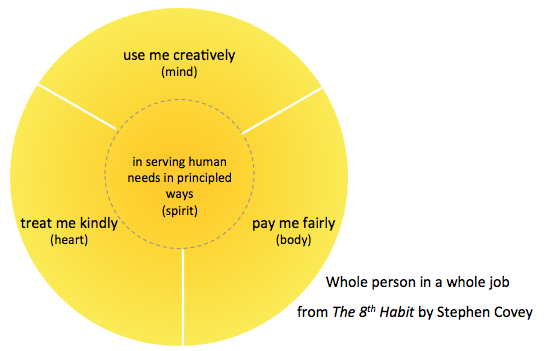
“People learn to understand their true nature and unique gifts. They use these gifts to create a vision of the great things they want to accomplish. With wisdom, they take initiative and cultivate a deep understanding of the needs and opportunities around them. They meet those needs that align with their talents, tap into their higher motivations, and create meaningful impact. In short, they find and express their voice. They serve others and inspire them to do the same. They apply timeless principles that nurture growth and prosperity in both individuals and organizations—principles that draw out the highest and best from the ‘whole person’—body, mind, heart, and spirit. And, crucially, they choose to influence and inspire others to find their voice through these principles as well.” (The 8th Habit, p. 26)
This process of finding and cultivating one’s voice is not just an individual endeavor—it’s a collective one. Leaders who embrace the 8th Habit are not only focused on their own development but are deeply committed to inspiring and empowering others to do the same. By creating environments that nurture individual expression and foster growth, we move closer to a world where people are no longer merely managed or controlled but are free to manage themselves in ways that are meaningful and impactful.
In essence, Covey’s 8th Habit calls for a transformation in how we view work, leadership, and management. It asks us to move beyond outdated industrial-era practices and to embrace a more holistic, empowering model of management that encourages people to develop their full potential and serve others in the process. This shift may be difficult, but it is not only necessary—it is inevitable. As Drucker foresaw, society will soon have no choice but to embrace this new paradigm, as the demand for self-management and personal responsibility grows exponentially.
