

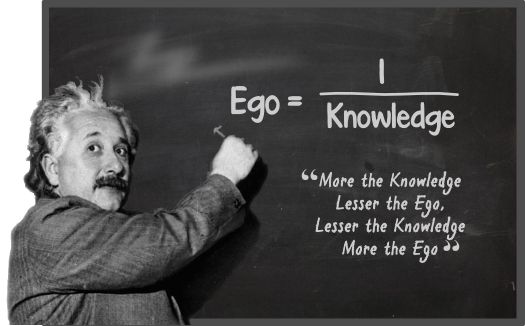
It shouldn’t be surprising that there are so many egotistic people out there. Let’s face it – most of us like to get praised and recognized for who we are, or what we do. Reinforcement of our self-importance feels like a highly addictive drug. It’s not hard to get carried away with it, especially if we actually have some basis to feel grandiose about ourselves. Needless to say, that kind of attitude is not built to last.
Your ego can be problematic. It can create a separate reality where you actually believe you know everything. In this reality, learning and expanding one’s knowledge is reserved for losers, who will never be as good as you are. Here you also never make mistakes. Ever. There was that one time, when it appeared as if you did, but it was clearly someone else’s fault. How about those people in your field that are clearly more successful than you? You somehow hate them, because you know they got there by luck, connections or by playing dirty. You are the real champ.
It’s not hard to see the pitfalls of the ego-driven reality. When you’re working to please your ego first, you are not necessarily doing what you should do to please your customer, other stakeholders or people in your personal life. Sure, those two may be aligned to an extent, but the egotistic approach can soon make you lose your focus. And what does an over-inflated ego do, when the situation backfires? It works extra hard to protect itself, digging you deeper and deeper.
Although humility may appear to be the virtue to strive for, an overly humble attitude may also not get you very far. The ego is inherently connected to one’s feeling of self-confidence, so getting rid of it may actually make the person feel doubtful and insecure, which is not the best attitude to have either.
So what about all those awesome humble people? How did they get to that point? Chances are, they haven’t always been like that. They might have been egotistic at one point until they managed to transcend it – probably by going the full circle until they eventually let go of the ego.
Note we said “let go of”, not “got rid of”. It turns out this is a crucial difference. Essentially, trying to get rid of the ego is fueled by the energy of fear and struggle. In other words, only an ego will try to get rid of the ego. Letting go on the other hand means something completely different. Ironically, it should come effortlessly – after a self-realization of one’s true nature as pure consciousness, which means that identification with ego ceases to exist.
While we live in an ego-driven society, most of us could clearly benefit from a quick ego check. A big ego is more often than not problematic, even if it seems to be working fine. Paradoxically, we shouldn’t try to get rid of the ego, but instead to let go and transcend it to the point where we identify ourselves with pure consciousness instead of the mundane, defensive and shallow construct that we call ego. It is not an easy journey, but this is where great, awe-inspiring minds come from. And that is the secret of the ego and humility. (aha!)
